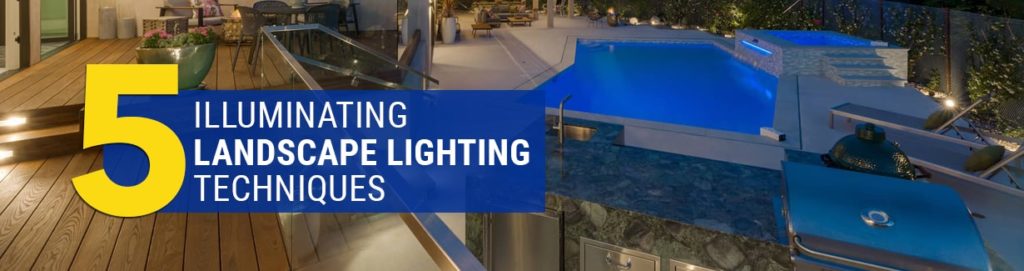
Great landscape lighting goes way beyond simply illuminating a path or flipping on a porch light. When done thoughtfully, it turns your home’s exterior into something you can’t stop looking at — showcasing architecture, drawing the eye to stunning trees, and wrapping your whole yard in a warm, welcoming glow. Whether you’re a first-time installer or looking to upgrade your existing setup, understanding these five core outdoor lighting techniques will help you think like a professional lighting designer and get results you’ll love.
Up-Lighting: Make Your Home’s Best Features Impossible to Ignore
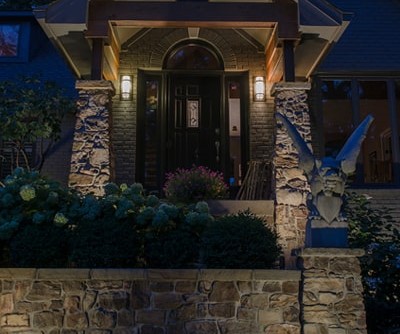
Up-lighting highlights stone, brick, and architectural detail with striking contrast.
Up-lighting is one of the most popular and impactful landscape lighting techniques available to homeowners. It works by placing LED spotlights close to the base of a structure or plant and aiming the beam upward, creating a bold, dramatic wash of light that immediately draws attention to whatever is being lit.
Unlike broad floodlights that cast a wide, even glow, up-lighting creates real contrast — highlighting textures in stone, brick, or stucco and giving architectural features genuine depth and dimension. Think arched doorways, columns, tall trees, decorative walls, or a front entry that deserves a second look.
The goal is to guide your guest’s eye to the most beautiful or intriguing parts of your landscape — whether that’s the architectural features of your home or standout elements like trees, statues, or fountains. LED spotlights and well lights deliver focused, directional beams that give you precise control over exactly what gets lit.
Silhouetting: Turn Plants and Sculptures Into Works of Art
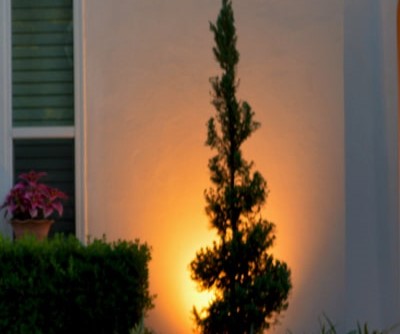
A spotlight behind low-growing plants creates striking silhouettes against lit walls.
Silhouetting is a landscape lighting technique that’s as dramatic as it sounds. Instead of lighting the front of a feature, you place a fixture behind it and aim the beam toward an adjacent wall or fence. The wall becomes an illuminated backdrop, and the feature in front becomes a striking dark outline set against that glow.
This approach works especially well with trees, large shrubs, ornamental grasses, garden sculptures, or any architectural element with an interesting shape or profile. The interplay between light and shadow creates a sense of mystery and visual depth that’s genuinely hard to achieve any other way.
Spotlights and well lights work best to create these dramatic shapes — their focused beams let you precisely control the angle so the backdrop glows evenly while the feature in front remains in beautiful contrast.
Shadowing: Add Movement and Drama to Any Facade
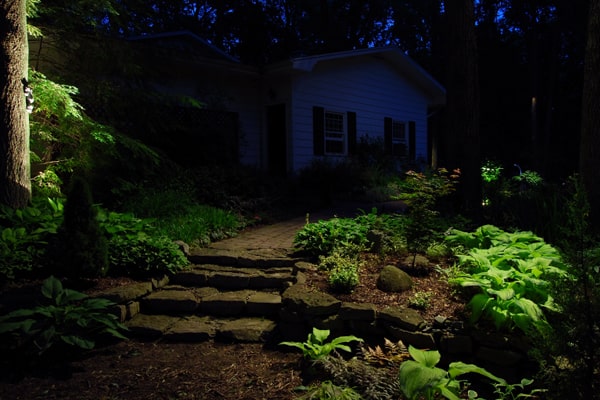
Layered fixtures cast soft, overlapping shadows across garden walls and planting beds.
Shadowing is a similar technique to silhouetting, but with a softer and more organic outcome. The fixture is placed towards the base of the feature and aimed toward an adjacent wall — but rather than creating a clean outline, the goal is to cast the feature’s shadow onto the surface behind it for a gentler, more painterly effect.
This technique is especially magical with trees that have open, delicate foliage. As the wind moves the branches, the shadow shifts and dances across the wall — turning something as simple as a breeze into a living, breathing part of your landscape design.
Spotlights, well lights, and floodlights can all achieve this effect. Placing the fixture closer to the base creates a larger, more exaggerated shadow; moving it back produces something subtler and more refined.
Moonlighting: The Most Natural Outdoor Lighting Effect You Can Create
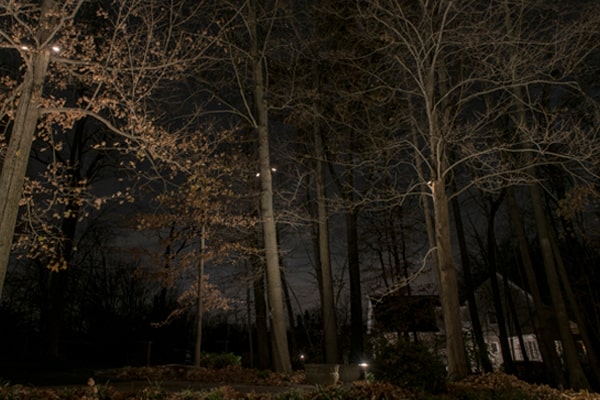
Fixtures high inside the tree canopy and pergola replicate the quality of natural moonlight.
Of all the outdoor landscape lighting techniques, moonlighting is perhaps the most beautiful and the most closely tied to nature. The idea is to mount a downlight fixture high up inside a tree, fitted with a full glare guard so the fixture stays hidden, and angle the beam downward through the branches.
The branches and leaves cast soft, natural-looking shadow patterns on the ground below — the kind of ambient, dappled light that makes an outdoor space feel truly magical rather than manufactured. This effect works best with open-branched trees that allow light to pass through freely.
This technique is a favorite for patios, garden paths, and lawns where you want beautiful ambient illumination that feels like it naturally belongs there.
Pro Tip
For the most realistic moonlighting effect, use a cool white or neutral white LED (around 3000K–4000K). The closer the light mimics actual moonlight, the more stunning the result.
Downlighting: Versatile, Practical, and Surprisingly Beautiful
Downlighting is the practical sibling of moonlighting — similar in concept but bolder and more functional. A downlight fixture is mounted high up inside a tree, on a trellis, under an eave, or on any elevated structure, and aimed downward to cast broad, even light over a large area below.
Where moonlighting is about atmosphere and subtlety, downlighting is about coverage and clarity. It’s an excellent choice for illuminating large sections of a yard, lighting steps and walkways safely, or flooding a seating area with warm, inviting light from above. Because the source is elevated and hidden, the effect feels natural — you see the light, not the fixture.
Place it higher for wide, sweeping coverage over a large lawn or patio, or lower to focus the beam on a specific path or garden bed. When combined with up-lighting or moonlighting in the same yard, downlighting adds the layer of practical brightness that ties a complete lighting design together.
Ready to Light Up Your Landscape?
These five techniques — up-lighting, silhouetting, shadowing, moonlighting, and downlighting — are the foundation of professional landscape lighting design. The best outdoor lighting systems use a thoughtful combination of all five, layering light sources, heights, and angles to create a yard that looks completely transformed after dark.
At VOLT® Lighting, we believe everyone deserves a beautifully lit home — and the tools, knowledge, and support to make it happen themselves. Whether you’re just getting started or ready to expand an existing system, our team of live lighting experts is here to help every step of the way.