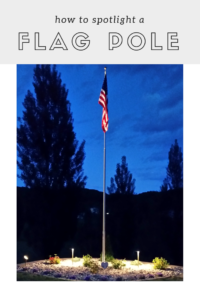
 According to U.S. Code Title 4, Chapter 1, Section 6(a): “It is the universal custom to display the flag only from sunrise to sunset… However, when a patriotic effect is desired, the flag may be displayed 24 hours a day if properly illuminated during the hours of darkness.”
But lighting the flag alone is not enough. You must also illuminate the pole to provide a visual path that starts at the ground, reaches into the sky, and ends at the glorious flag. But how do you light a flag pole?
The Fixtures
What type? Directional lights must be used since they provide the narrow beam spreads required for lighting a flag. Of directional lights, either spotlights or in-grade lights may be used. If you need to install the fixtures on turf, in-grade lights are often the best choice. Alternatively, our brass or copper spotlights may be mounted in turf with ground stakes, or you can use an aluminum flag pole mount to attach an aluminum spotlight to a pole. Don’t use an aluminum flag pole mount with brass spotlights; aluminum mounting threads will corrode over time if they’re in contact with brass.
How many? You need at least two (but ideally three) fixtures to illuminate a flag. This ensures that the shadow of the pole will not obscure the flag.
Located where? You need to illuminate both the flag and the pole, so one fixture must project light onto the pole as close to the ground as possible. This fixture should be within about 1 foot of the pole or mounted on the pole itself. If using more than one fixture, the others can be mounted in the most convenient locations, at any practical distance from the pole. Just one fixture can illuminate the pole, which is nearly always white and requires much less light than the flag.
The Light
How bright? Your flagpole and flag should be the brightest objects in your illuminated landscape. The red and blue colors of the flag require very bright lights because they absorb a lot of light.
- If using integrated LED fixtures, the fixture light output must be at least 300 lumens. For very tall poles, consider the G4 Infiniti™ 40 LED Spotlight, which has a bright 500 lumen output and interchangeable optics (sold separately) that include 17º and 24º – both likely beam spreads needed for your flag.
- With lamp-ready fixtures, the bulb’s light output will be slightly higher than the fixture’s, so select LED outdoor bulbs that produce more than 300 lumens. Our 5W MR16 LED bulb is a good choice; it has a 400 lumen output and is a 30W halogen equivalent. Bear in mind, halogen equivalents vary by LED bulb manufacturer. And with LED bulbs, lumens (not wattage) indicate brightness.
How narrow or wide? Use the narrowest possible beam spread to focus as much light as possible on the flag. That said, the flag can wave in any direction, so the beam must also be wide enough to fully illuminate the flag regardless of its position around the pole. For example, if you have a 6-foot wide flag, the beam spread must encompass a circle with a radius of 6 feet from the pole. If using multiple fixtures to achieve this beam spread, aim them precisely so their beams overlap. Please see the chart below to calculate optimal beam angles based on pole height and flag width. And if you have any questions about this or any other landscape lighting project, please give us a call at (813) 978-3700. Our experts are on hand 7 days a week to help.